Zinnhub is a brand-new global freelance platform — bespoke-built, launched in 2026, and designed from the ground up to take on the Fiverrs and Upworks of the world. The product is genuinely excellent. But a brand-new marketplace, however good, runs into the same wall every new platform hits on day one: sales. You can have the best platform in the world, and it’s worth very little until buyers and sellers are actually using it.
That’s the problem I was brought in to crack — and the way I cracked it wasn’t with an ad budget. It was with a partnership.
Two problems that were each other’s answer
I’d already built a marketplace into PBN.LTD — one that was already selling backlink products and had a steady, built-in stream of buyers coming through every day looking for exactly that. (It’s the same marketplace I used to grow PBNLinksForSale.)
Zinnhub had the opposite problem: plenty of talented sellers offering backlink services, but not yet the flood of buyers to match. One business had buyers and wanted more to sell them; the other had sellers and needed buyers. Put like that, the answer was obvious — connect the two.
Plugging Zinnhub into PBN.LTD
So that’s what I did. I pulled backlink-specific listings from Zinnhub straight into the PBN.LTD marketplace. Almost overnight, PBN.LTD had a richer, fuller catalogue of backlinks to offer — and Zinnhub’s sellers had a whole new shopfront putting their services in front of ready-to-buy customers, without having to go out and find them.
A deal where nobody loses
The clever part is how it’s structured, because this isn’t a markup play. I arranged it so the products sell for the exact same price on PBN.LTD as they do on Zinnhub — the buyer pays not a penny more wherever they buy. Instead of marking it up, Zinnhub shares a slice of its own seller fee with PBN.LTD on every sale that comes through it.
Line it all up and everyone comes out ahead:
the freelancers on Zinnhub get more sales, from buyers they’d never otherwise have reached;
Zinnhub gets its name out there and real revenue through the door while it builds momentum;
PBN.LTD earns on every sale and ends up with a fuller, more varied marketplace;
and the buyers get more backlink options to choose from, at no extra cost.
Four winners and no losers — that’s the kind of deal that actually sticks.
This is business development
None of this took a big budget or a clever trick. It took spotting that two businesses had gaps that were, in fact, each other’s solution — and then structuring a deal where every party had a genuine reason to say yes. That’s business development done properly: not squeezing one side to prop up another, but finding the arrangement where growth for one becomes growth for everyone.
If you’ve got a great product that just isn’t selling yet, the answer isn’t always more ad spend — sometimes it’s the right partnership, with the right people, structured the right way. That’s exactly the kind of growth work I do. Drawing on 15+ years of building and growing businesses, I’ll help you spot the opportunities hiding in plain sight. Get in touch and let’s talk.
When I came to PBNLinksForSale.com, the business did one thing: it sold PBN links from its own private blog network. And it sold them well. But “well” and “as well as it could” are two very different things — and there was a lot of money being left on the table.
My job was to change that — not by pushing harder on the one product it already had, but by turning a single-product site into somewhere customers come back to again and again. Here’s what that involved, and how it more than doubled the revenue in a matter of months.
The gap nobody was filling
Here’s the thing about people who buy PBN links: they already know not to put all their eggs in one basket. A healthy backlink profile is a diverse one — different link types, different IP pools, different sources — because that’s what looks natural and that’s what lasts. So every single customer buying PBN links was, by definition, someone who also needed other kinds of links and services. They were just going elsewhere to get them.
That was the opportunity staring the business in the face: it was selling one slice of what its own customers already wanted, and waving goodbye to the rest.
From a few link packages to a full menu
So I built the rest out. I created custom packages well beyond the private network — real, diversified backlinks from guest posts and forum placements — and a whole range of services around them: content writing, malware removal, database cleanups and more. Some of it the team could deliver in-house; for the rest, I sourced and vetted the right partners — other reputable link providers and real website owners — so it could all be offered under one roof.
Almost overnight, PBNLinksForSale stopped being “a few link packages” and became a proper menu, with genuine room to upsell and cross-sell. Someone arriving for PBN links could now round out their entire backlink profile in one place — and the average order grew right along with them.
Making sure people saw it
New products only earn their keep if people know they exist. So I put the expanded range front and centre on the site, and pushed its visibility well beyond it too — press releases, forum placements and the kind of off-site presence that builds authority and gets a brand mentioned in the places buyers (and, increasingly, AI) actually look.
And here’s the part I’m proudest of: I ran all of that using the exact packages and products I’d just added to the site. Every press release, every placement, every link was one of their own services, put to work on their own domain. So the off-site push didn’t just bring traffic in — it proved, in public, that what I’d sourced was the real deal. Their own website became the proof: the best advert for the products was the authority and rankings those very products had built for it.
A blog that brings customers in
I also write the entire blog — every word of it. Not thin, keyword-stuffed filler, but genuinely in-depth, useful content that answers the questions real buyers are actually asking. That’s the kind of content Google rewards and readers trust, and it pulls double duty: it ranks, and it brings in new customers who arrive already confident the site knows its stuff. It’s the same quality-first approach to SEO I bring everywhere — content built to earn its rankings and keep them.
Smarter recommendations
I also sharpened the site’s backlink recommender so it does a far better job of matching each customer to the packages that genuinely suit them. Better recommendations mean people find the right thing faster, trust the advice they’re given, and buy more of what actually helps them — instead of guessing, second-guessing, and leaving.
The 1% that made the biggest difference
Then I completely overhauled the email side and automated it end to end. Customers now get the right message at the right moment without anyone lifting a finger — including “we miss you” emails that gently bring lapsed buyers back and remind them there’s a real person on the other side who’s got their back.
It sounds like a small thing. It really isn’t. I firmly believe the little 1%s are what quietly make up a huge chunk of a business — and this is a perfect example: a handful of well-timed, fully automated emails that keep bringing revenue back in, month after month, entirely on their own.
The result
Within a few months, the site’s revenue had more than doubled. Not from one big swing, but from a stack of the right moves working together: customers arriving to find things they didn’t know they could buy, buying what they came for and more, discovering the site through content that ranks, and being drawn back by emails that actually land.
That’s what happens when you stop thinking about a business as the one thing it sells, and start thinking about everything its customers actually need. It’s the same end-to-end approach I took to rebuilding PBN.LTD — strategy, product, content and marketing, all pulling in the same direction.
If your business is doing well but you can feel it could be doing better — more to offer, more reasons for customers to return, more revenue from the traffic you already have — that’s exactly the kind of growth work I do. Drawing on over 15 years in SEO, content and growth, I’ll help you find the money being left on the table and go and get it. Get in touch and let’s talk.
Vivastreet is one of the biggest classifieds platforms around — the kind of site with real scale, and serious competition for every term that matters. I worked with them on an SEO campaign more than ten years ago, in the period before they built out their own in-house team and brought everything under one roof.
I’m bound by an NDA, so I can’t tell you which pages or which search terms I worked on. But I can tell you what happened to them — because it’s the part I’m proudest of.
Rankings that still stand, ten years on
Those pages are still sitting on page one of Google. Not for a few months, not for a year — for the last ten years, without interruption. They’ve never needed to be touched again, never needed re-working, and never needed rescuing.
In that decade, Google has rolled out update after update — the kind of algorithm changes that routinely wipe out rankings built on shortcuts. Those pages have weathered every single one and stayed exactly where they were put: right at the top. In an industry where most rankings need constant feeding just to stand still, that kind of durability is rare — and it’s no accident.
How I did it
I started where most people don’t: with everything that was already there. Before adding a single thing, I personally went through the work that had already been done — on the site and off it. I audited the existing backlink profile, mapped the site structure and the internal linking, and worked out exactly what was holding those pages up and, just as importantly, what was holding them back.
I looked hard at the quality of what was already pointing at the site — which links were doing real work, which were dead weight, and which were an actual risk — and then, rather than tear it all up and start over, I built on the foundation that was already working. I tightened the internal linking and the structure so that authority flowed to the pages that mattered most, and I pushed genuine authority into them: quality, relevant links, placed carefully and at a natural pace, varied enough to look like exactly what they were — a good page earning good links.
And every bit of it was done safely. No shortcuts, no manipulative tricks, nothing that would look clever for six months and then collapse the moment Google tightened the rules. Just solid, white-hat SEO built on a proper foundation.
Why it lasted
That’s the whole point — and it’s the difference between SEO that costs you forever and SEO that pays off for years. When rankings are built on real quality and authority rather than loopholes, they don’t need babysitting, and they don’t fall over when the algorithm shifts. The pages I worked on were built to last, and ten years of Google updates have proved it.
It’s the same built-to-last approach I bring to every project — whether that’s a national SEO campaign or rebuilding an entire hosting platform. Do it properly once, and it keeps working long after the invoice is paid.
Want rankings that actually stick?
If you want SEO that holds — rankings still earning their keep years from now, not quietly slipping every time Google sneezes — that’s exactly the kind of work I do. Drawing on over 15 years in SEO and search, I’ll tell you honestly what’s working, what isn’t, and how to build something that lasts. Get in touch and tell me what you’re trying to rank.
PBN.LTD is a specialist hosting platform built for the SEO industry — thousands of sites running across its network, with customers all over the world. I’ve worked with them for years, and my role is about as hands-on and wide-ranging as it gets. I don’t just advise on what should change — I design it, build it, run it, and I’m the one customers hear back from when they need help.
When I came in, a fair amount of the platform had been left half-built or half-working by a previous development team. So the job has been two things at once: get everything working properly and reliably, then push the whole product forward — the website, the customer dashboard, the billing, the infrastructure underneath it, the support, and the marketing that brings new customers in. All of it is live today — and this is the full picture of what “doing the work” really looks like.
A website that finally matches the product
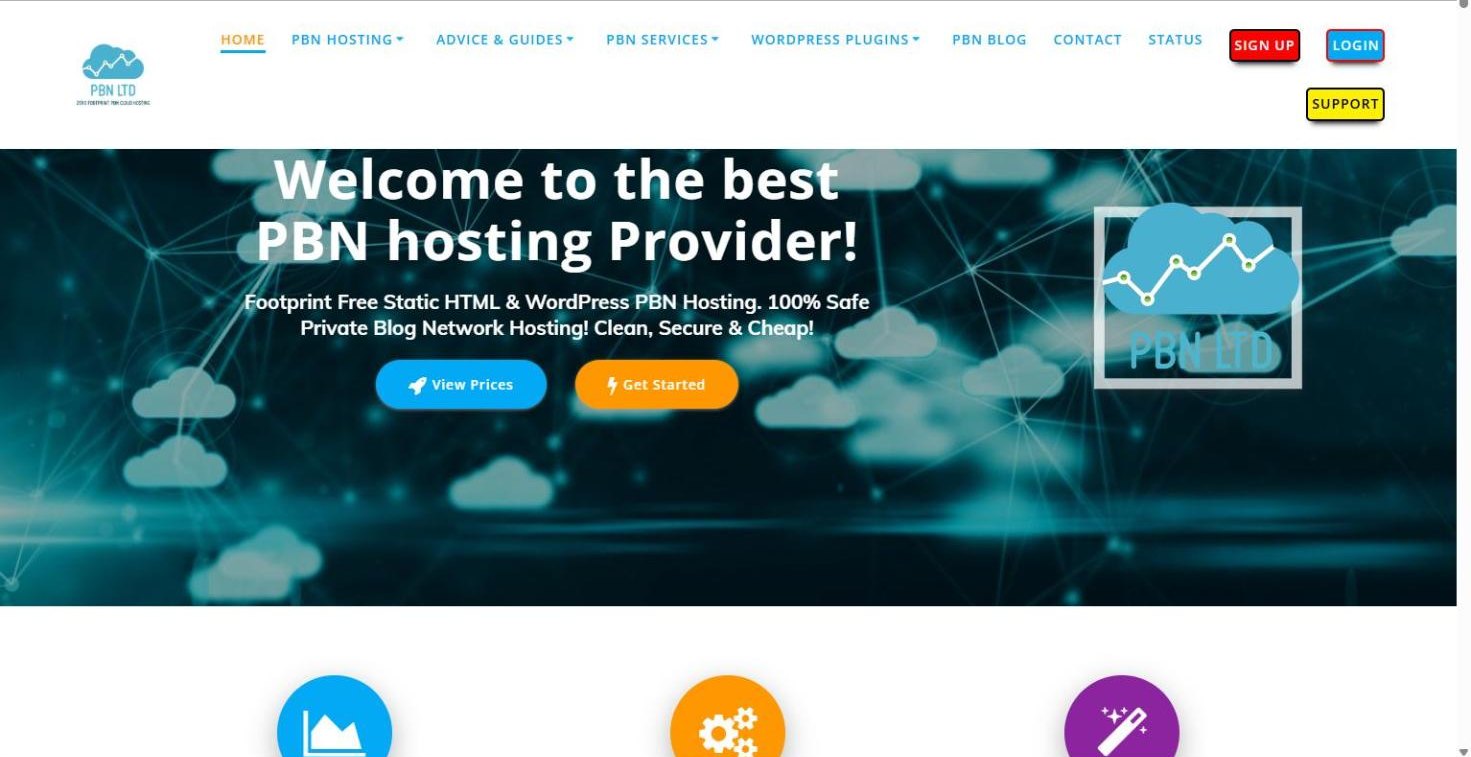
When I took on the website, it looked its age. A busy, templated homepage, mismatched colours, stock imagery — and, worst of all, nothing that actually explained what made the platform different or better. For a company selling technical hosting to a clued-up audience, it undersold everything.
Before — the original site.
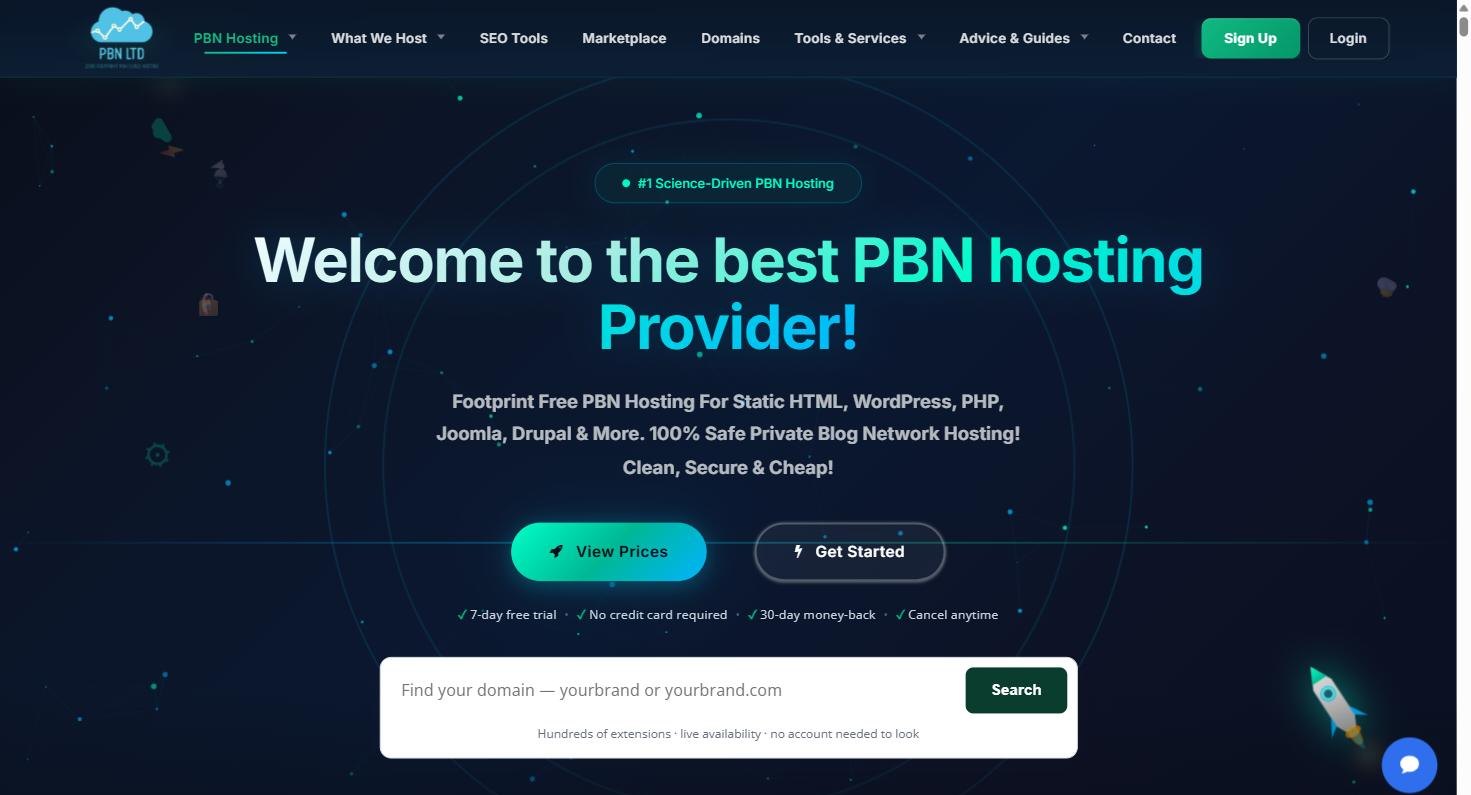
I rebuilt it from the ground up — the same kind of web design and development work I do for my own clients. A clean, modern, science-driven brand with one clear message, proper trust signals (a free trial, no card required, a money-back guarantee, cancel anytime), a live domain search built straight into the homepage, and live chat so questions get answered before they turn into a lost sign-up.
After — the site today.
It isn’t just a fresh coat of paint. Every element on the page now has a job — explain the product, build trust, and move the right person towards starting a trial. It’s the front door to everything else below, and it’s built to convert.
A knowledge base customers can actually use
A hosting platform lives or dies on support, and the fastest support of all is the kind where the customer never has to ask. So I built PBN.LTD a complete knowledge base from scratch — every feature, every workflow, every common fix, documented in plain English instead of jargon.
Then I plumbed in semantic search. Rather than making people guess the exact keyword an article was written around, they can describe their problem in their own words and still land on the right answer. Customers help themselves faster, the support queue stays shorter, and the knowledge base quietly handles a chunk of the support load around the clock.
Putting customers in control of their own sites
A lot of the work has been about handing customers real visibility and control, so they’re never in the dark and never stuck waiting on a ticket for something they could do themselves.
That means error logs surfaced right in the dashboard, so someone can spot a PHP issue and fix it without raising a ticket. Each site’s live status — online or offline — visible at a glance, so nobody has to check by hand. Real-time database and site-size usage, so when a customer is making fixes they can see the effect immediately. And clear in-dashboard notices, with top-up links, when a site reaches a usage cap — no silent surprises.
On top of that, there are bulk tools for people running large accounts — updating PHP versions or making an account-wide change in one go instead of site by site — control over PHP settings and modules, a proper onboarding walkthrough for new users, an announcements area, and simple built-in ways to report a bug or suggest a feature. The direction is always the same: fewer locked doors, less guesswork, and a dashboard that makes sense to normal people, not just developers.
Billing that works the way customers actually do
Payment is where a lot of hosting companies quietly lose people, so flexibility matters. So I rebuilt the billing to bend to the customer instead of the other way around: pay monthly, quarterly, every six months or yearly; upgrade or downgrade at any point — not only at the next renewal — whether someone pays by card, PayPal or crypto; full invoices and complete payment history in the dashboard; and VAT handling built into checkout for the businesses that need it.
There’s a win-back side to it too — reconnecting with customers who’ve drifted away and giving them a real reason to come back, rather than letting them go quietly.
A platform that looks after itself
The least glamorous work is often the most important. A lot of my focus has gone into making the platform robust and as hands-off as it can be: proactive monitoring and automated recovery, catching problems early and, wherever possible, fixing them before a customer ever notices.
That includes near-instant reactivation, so when an account is paid or a site is unfrozen it comes straight back rather than crawling back one at a time; automated migrations, so moving a site between servers is clean and safe instead of manual and risky; proper backups and snapshots, with a paid hourly-backup option for customers who want it; and honest capacity monitoring behind the scenes, so scaling the servers is something I plan for in advance rather than scramble to react to.
Turning a hosting platform into a marketplace
Hosting is the core, but there’s far more a platform like this can offer — and a big part of the work has been turning PBN.LTD into a genuine one-stop shop customers can buy from without jumping through hoops.
That means a proper domain marketplace: buying aged domains straight through the dashboard, searching by the metrics that matter, registering brand-new domains, and even letting customers safely sell their own. It means the extras people already ask for — backlinks, done-for-you PBN builds, malware and database cleanups — available as a quick in-dashboard purchase rather than a back-and-forth. And it means add-ons that make the platform genuinely stickier: rank and keyword tracking, AI-visibility tracking and content, staging environments, extra databases and storage, mainstream one-click hosting for money sites, and an affiliate programme to bring new customers in through word of mouth. Every one of those is a better experience for the customer and a new line of revenue for the business.
Modernising what’s under the hood
Alongside everything customers can see, I’ve been dragging the platform itself up to date — refreshing an ageing stack, bringing dependencies up to current versions, and finishing off the parts that were never done properly the first time. I’ve also built the connective tissue a modern platform needs: a customer-facing API with proper documentation so people can plug PBN.LTD into their own tools, delegated access for teams, a single merged system for live chat and support tickets, a proper email and email-marketing setup, and mobile apps for both customers and admin.
The growth engine: Google and Reddit
None of this matters if nobody’s coming through the door, so I also run the entire paid acquisition operation — Google and Reddit campaigns, end to end. That’s the strategy, the targeting, the ad copy, the conversion tracking and the constant day-to-day tuning, all drawing on my years in SEO, Google Ads and marketing. I handle the technical side of tracking too, making sure campaigns optimise towards real sign-ups and payments rather than vanity clicks, and that every traffic source is attributed properly so I always know what’s actually working.
Right now those campaigns bring in more than 250,000 tracked visits and over 500 new paying customers every single month — and because I manage all of it directly, every pound of ad spend is held to account.
And I’m who the customers actually deal with
All of it feeds one thing: a platform people can rely on and a company that’s easy to deal with. Day to day I’m the human on the other end — answering customer emails, working directly with the SEO clients, and handling the support tickets. Being that close to customers isn’t a side job; it’s where half the roadmap comes from. Every recurring question is a clue about what to document, automate or rebuild next, so the support work and the product work constantly feed each other.
The short version
PBN.LTD isn’t a project I wrote a report for and walked away from. It’s a platform I’ve redesigned, rebuilt, automated, monetised, marketed and supported — and I’m still pushing it forward. That’s what “done-for-you” really means when I say I’ll do the work: not advice from the sidelines, but someone who’ll take the whole thing on and run it like it’s their own.